Camly - A Responsive Blogger Theme, Lets Take your blog to the next level.

This is an example of a Optin Form, you could edit this to put information about yourself.


This is an example of a Optin Form, you could edit this to put information about yourself or your site so readers know where you are coming from. Find out more...


Following are the some of the Advantages of Opt-in Form :-

  • Easy to Setup and use.
  • It Can Generate more email subscribers.
  • It’s beautiful on every screen size (try resizing your browser!)
Showing posts with label FOSS. Show all posts
by · No comments:

FUDCon 2016 Phnom Penh, Cambodia


I was selected for delivering a talk on WikiToLearn at the FUDCon APAC, Phnom Penh, Cambodia from 4th to 6th November, 2016.


FUDCon (Fedora Users and Developers Conference) is an important event in the world of free software that is held in different parts of the world organized by Fedora Organization. The FUDCon comprised of sessions, talks, workshops and hackfest in which project participants worked on specific initiatives. FUDCon Phnom Penh was conducted at Norton University, Phnom Penh along Barcamp ASEAN. Around 50 speakers from around the world gave talks related to entrepreneurship and open source software. I was traveling with one my friends, Abhinand N, who also got selected to deliver a talk on Mediawiki. Looked like, we were the only two undergrads who were invited to deliver talks.

It was my first international trip and pretty amazing. My itinerary was something like this : Cochin -> Kuala Lumpur -> Phnom Penh (4th November) and Phnom Penh -> Bangkok -> Cochin (9th November).

Phnom Penh looked more or less like an Indian city just with more prettier girls (:D) and no public transport. We reached Phnom Penh on 4th evening, and a tuktuk driver was waiting for us at the airport to take us to the hotel. If you're wondering what a tuktuk looks like, see this :


As soon as we reached Hotel, it was almost Dinner time. Sirko Kemter was the local organizer and all the developers decided to go to a nearby BBQ place. Remember, Abhinand is a pure vegeterian and he came to eat BBQ (:P). Anyway, the food was great, since I had never tried Lobster and Prawn. Amazing experience, it was.

At the time of dinner, I interacted with rest of the Fedora developers from India, Australia, China and USA. Kushal Das, Sayan Chowdhary were among the famous open source developers from India. It was great meeting and interacting with them.

Day 1 : FUDCon APAC, Norton University, Phnom Penh

FUDCon Day 1 was pretty amazing. We started off with Barcamp pitches followed by Fedora State of the Union talk from Brian Exelbierd, Fedora Community Action and Impact Coordinator.


The first talk I went to was Introduction to Rust Programming Language by Kanika Murarka. Kanika actively contributes to Fedora, and is an intern at Red Hat, Bangalore. She engrossed us, telling that Rust is designed to be a safe, concurrent, practical language, supporting functional paradigms and is sponsored by Mozilla.


Lunch was pretty interesting. Everyone gathered at a common lunch place with full of local khmer snacks, jackfruits, veg fried rice and non veg rice. Veg food had egg in it, so yeah! (:D) Lunch was okayish, but what made it interesting was the discussion! I had a long discussion with Sumantro Mukherjee and Parag Nemade about my project and it was great! After the discussion, we followed for the next series of talks.


Next talk, I went onto was How to globalize your software by Parag Nemade. Parag Nemade is a Senior Software Engineer at Red Hat. He is an active contributor to Fedora project, sponsor for packager group, proven packager, helps in improving Fedora packaging and testing Fedora updates. Parag introduced us to Globalization. It is a collaborative work done by internationalizing, localizing your software. He told us how important it is to globalize the code you write. Then he told what Localization is and how to add internationalization in code by showing some code examples. It was a great talk!


The following talk was by Alex Eng on Zanata, a translation platform. One of the best and interesting talk for the day. Alex presented a round up of the new features that will be available in the next release of the translation tool. I was very eager to learn more about how Zanata works, and therefore had a brief conversation with him. I was fascinated about the new editor and discussed  my GSoC project and collaborative editing would work in Zanata. Handling translations is very challenging and great thing is that, WikiToLearn is also looking for ways to implement Zanata.


The next talk was on Web Virtual Reality by Sumantro Mukherjee. The highlight of the talk was a-frame. A-frame is a web framework for building virtual reality experiences and works on almost all devices. With just few lines of code, you can turn a video into 360 degree Virtual Reality. Amazing, isn't it?


The last talk of the day was by Anwesha Das on A walk on licenses in Fedora ecosystem. She gave an overview of all the open source licenses, why it is important to use a license and what are the best practices of using a license. The take from the talk was not to use personalized licenses and even if you use it, not to name it like Buy me a beer or something similar. Overall, it was great to learn about Licenses.


The day ended with all the Indians and Ryan going to a Riverside Restaurant and having amazing food.

Day 2 : FUDCon APAC, Norton University, Phnom Penh

Day 2 started with heavy rains at Cambodia. Thanks to Sirko for providing raincoats! It was another day of interesting talks and I had my talk at 3pm.

The first talk I went to was by Noriko Mizumoto on How can you help us get Fedora to the world?. Noriko hails from Japan and is a Community Relations Specialist and Program Manager, Red Hat Asia Pacific. Noriko focused on the importance of localization. Localization of a software is very important, since non-native English speakers are much more when compared to native English speakers.She introduced how Fedora has been localized into over 80 languages. A great talk, indeed.


Following was the talk on Exploring Fedora Infrastructure by Sayan Chowdhary. Sayan Chowdhary is a Senior Software Engineer at Red Hat, Pune and has been a Python developer contributing to Fedora. Sayan talked about Fedora web projects and how can one contribute to them.


Next was the talk by Kushal Das on Testing Fedora Atomic in an automated way. I don't need to introduce him (:P). He talked about testing fedora atomic project in an automated way by using Python and Go script made by him. It went over my head mostly, since I never contributed to Fedora. Anyway, it is always amazing to listen him speaking. The way he explains a scenario, is absolutely stunning.


After the better lunch, next talk I attended was on Fedora QA by Sumantro Mukherjee. Sumantro introduced us to Fedora Quality Assurance, the workflow and how to test a package. Great talk, indeed.


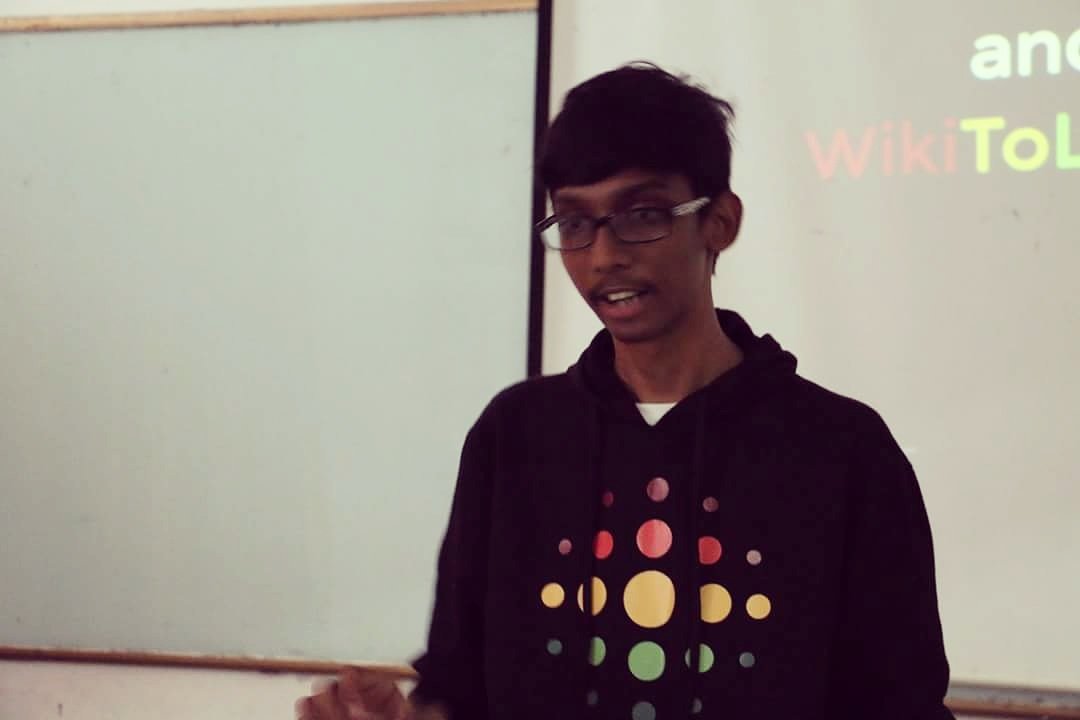
Now, it was time for my talk on WikiToLearn : Bringing Academia to the Internet Era : A revolution in Knowledge Sharing. I introduced WikiToLearn to the attendees, how to contribute and gave them a hand-on session on "How to make a personalized book". I briefed on how WikiToLearn is being adapted at European Universities and making it easier for students and professors for collaborative learning. I spoke on who/how can contribute being a student, teacher, translator or hacker, how the project is having powerful impact not only in Europe but also in the world with many universities involved and also organizations like KDE, Wikimedia Foundation and the CERN, About the power of collaboration and its impact in academia with the help of WikiToLearn and also how students and professors are using it in their universities as a tool to make learning much more effective in a collaborative way. Slides for the talk can be found here.


The last talk was on Contributing to Mediawiki by Abhinand N. Abhinand is a Google Summer of Code'16 select for Mediawiki. He actively contributes to Mediawiki. He introduced attendees to Mediawiki and how can one contribute to Mediawiki by code. He briefed about Gerrit and the workflow of patch submition. It was a great talk, too.


We had a great party after the talks at Fudpub with Barcamp organizers. Free beer, yaay (:D).


This was the first time, I attended Fedora event and it was amazing to meet and interact with developers around the world. Kudos to the local organizers and KDE for sponsoring my trip. Overall, it was an amazing experience which I'm going to cherish for long.
Read More
by · No comments:

MediaWikiToLearn Hackathon + Editathon


FOSS at Amrita presents you for the first time in India, MediaWikiToLearnHack-a-thon and Edit-a-thon in collaboration with Wiki To Learn andWikimedia Foundation at Amrita University, Amritapuri Campus.


Background

FOSSatAmrita, is a student community at Amrita University, Amritapuri Campus. Being one of the most active student communities on the campus, we encourage, support and mentor students to improve their technical and social skills through contributing to open source. We aim at encouraging students to embrace the free and open source approach that is fast gaining momentum. We are a community of students and mentors that support and guide each other towards making open source contributions, and towards the usage of free software. This year, FOSSatAmrita gave 10 selections in Google Summer of Code and 1 in Outreachy, that shows the potential in the students of FOSSatAmrita club.


To ensure more open source contributors, we are bringing this two day hackathon, for the very first time in the history of Amrita University, Amritapuri Campus. MediaWiki is organizing a two-day hackathon to help students understand the working of the MediaWiki and WikiToLearn community. Two days long hackathon would include every aspect — from installing the software, setting up the environment to fixing some easy bugs and submitting the patches for review. (Don’t worry if some of the words don’t make any sense now, we’re here to answer all your queries!)

The program will run from 01st-02nd October with the two parallel tracks:

MediaWiki Hackathon: Run by invited developers and existing MW contributors in the club. Expected participant count of 50, and all requests handled by the below mentioned Google Form. Participants will be given guidance and opportunity to code contribute to the Wikimedia codebase, sending in patch sets, and understanding the code review process. This would make them head start into upcoming Google Summer of Code 2017 and other internship opportunities.

WikiToLearn Edit-a-thon:Teachers and students get together to collaborate and develop open course content on en.wikitolearn.org. Teachers would participate by either editing or reviewing contents in the wiki. This will make it easy for teachers and students to have a structured method to communicate online over academic materials.
Added Benefit

Are you willing to apply for Google Summer of Code (GSoC) but don’t know how to start?

Well, that’s problem everyone faces at the onset of joining the open source communities.

Attending this workshop would give a clearer picture to anyone who’s willing to apply to the open source scholarship programs like Google Summer of Code (GSoC) and/or Outreachy but lacks direction or information. This workshop will leave you with a better understanding of how you may proceed with contributing to an organization of your choice, thus significantly boosting the probability of you getting selected! \o/\o/

Details

Date Saturday and Sunday, October 1 and 2, 2016 Time 10 AM to 8 PMVenue Ground Floor Lab, Amrita University, Amritapuri Campus Contact foss@am.amrita.edu Hashtag #MediaWikiToLearnHack Register Register here. IRC #mediawiki on FreeNode Report Photos Bug fixes and links to patches :
Facilitators
Abdeali JK
Tony Thomas
Abhinand N
Devi Krishnan
Srijan Agarwal
Registration

Fill this Google form to register yourself for the workshop. Since we have limited slots available, we’ll keep the event limited to the registered students.

Note on the registration Prerequisites: Please note that you are cloning the development master branch of mediawiki-core form gerrit.wikimedia.org, preferably over SSH. Please follow Gerrit Tutorialtopdown to complete in both the tasks, and in case of any questions, do ask in #wikimedia-dev or #mediawiki or contact the FOSS club at foss@am.amrita.edu
Hackathon Pre-requisite

To make sure all attendees are at the same phase, please ensure that you have the following setup in your machine:
Any working Linux environment, with LAMP server installed. You can find the installation steps for LAMP in Ubuntu here
Any powerful PHP IDE, PHPstorm recommended. You can find the instructions here.
An account in Wikitech, Gerrit, Wikimedia Phabricator, and Github
Try cloning and setting up Gerrit in your machine following the instructions given here
Try connecting with #wikimedia-dev on IRC freenode channel

Important: We are expecting the participants to have a clone of MediaWiki-core downloaded and installed in their machine before hand, so that we can start early with the contribution phase. You can find the detailed instructions on how to setup development environment for Mediawiki in theGerrit/Tutorial

In case you do not have any prior know-how of PHP, Version control or web applications : You are welcome to try setting up a simple registration and login web application in PHP beforehand, in your machine. You can find sample code for the same here. You will have to setup LAMP or similar stack in your machine to test the code locally.

Why Should You Attend?

Reading through the large open-source code base and contributing as code: Increasing their technical and code scripting skills, solving simple to complex real-time problems existing in Mediawiki software.
Motivated students reaching out and getting into internship opportunities like Google Summer of Code and Outreachy: Along with building a strong hold in technical stuff, internship programs like GSoC and Outreachy allow its interns to work on major problems, proposing and implementing their solution under expert mentorships. The selected students get a considerable stipend and its a major addition to the institutional record too.
Active community engagement and other opportunities The workshop would add to the technical know-how of the participants while working closely with a worldwide Wikimedia community, which is the fun part.
FAQs

What you need to know

You need to have some sort of prior experience developing stuff (web apps, mobile apps, data mungers, anything at all!). There are a variety of things you can do (CSS/JS hacks, webapps that use the API, Mobile apps, data mining) that pretty much anyone with some developer experience is bound to find something fun to do. This is a hackathon, and not a workshop.
Knowledge of Free Software License, comfortable using any Online Project hosting websites (like Github) since we would want you make the code you write for the hack freely available, online.
If you feel you might not have anything listed here, think about taking a look at these courses:
Learn PHP online with codecademy
Learn the command line with codecademy
Learn Git online with try.github
Learn bit of Python with learnpython
Go through this repo on Contributing to Open Source and see what you can make out of it.

What language can I use

Any programming language you are comfortable with and can make sense of the MediaWiki code base
Life would get easier if you have some prior programming experience in PHP since most of the MediaWiki code is written in PHP

How can I prepare for the Hackathon
Read through links in Resources, check out the Examples.
Feel free to ask questions! Contact us.

What qualifies me to come
Show us some code you have written, tell us what you know, tell us why you love hacking (and Wikipedia) in general, and you’ll get the pass :)
Please sign up here.

How to spread the word
Pass on the word to your fellow geek friends.
Use #MediaWikiToLearnHack on Twitter.
Read More
by · No comments:

Failing GSoC! A hell of an experience!

So, yeah. I failed the final evaluations of Google Summer of Code. I didn't expect it, but I think I should have added more features to my project and worked harder. To be honest, this was one hell of a summer. Working on such a project, OfflineExtension for WikiEditor, with such an awesome community WikiToLearn and such cool mentors, Gianluca Rigoletti and Irene Cortinovis, is worth millions. I couldn't pass the final evaluations, but I gained so so much that I have no hard feelings. Of course, I felt bad, but at the end, the experience is all that matters. Thanks, Google and WikiToLearn for giving me such an amazing opportunity. I would work more on my project and try to get it in the production mode, as soon as possible. Also, I will reapply for Google Summer of Code next year too with the same organization, and will definitely pass :'). And, the bad part ends here. Good news is that I'm now a core developer of WikiToLearn, and I find this opportunity to be more worthy than being a GSoCer, so this.failure eventually equals to this.success (Sorry for this, I'm learning JAVA :P ). Thanks, Riccardo and Gianluca for giving me this oppurtunity. I’ll give my best, work harder, learn and will contribute to  as much as I can. :)

Long Live WikiToLearn, Long Live KDE, Long Live Mediawiki and Long Live FOSSatAmrita! :)
Read More